Pools
Why Is Your Pool Losing Water in Abu Dhabi?
7 August 2026 · 7 min read
If you have noticed the water line creeping down between top-ups, the first question is always the same: is this just evaporation, or do I have a leak? In Abu Dhabi's climate, some water loss is completely normal and nothing to worry about. But there is a simple, reliable way to tell ordinary evaporation apart from a real leak, and this guide walks through both, so you know which one you are dealing with before you call anyone.
Why pools lose water faster in Abu Dhabi's climate
Every pool loses some water to evaporation, but the rate varies enormously with climate, and Abu Dhabi sits at the demanding end of that scale. Intense heat and strong UV exposure through most of the year pull moisture off the surface far faster than they would in a temperate climate, so a drop of a few millimetres a day in peak summer is often just the sun doing its work.
Two other local factors quietly add to the rate of evaporation over time. Desert dust settles into the water and on the surface, and the heavier chlorination many pools need to stay sanitised in the heat both raise the total dissolved solids (TDS) in the water. As TDS climbs, the water's surface tension and evaporation behaviour shift, and pools with high TDS tend to lose water a little faster than freshly balanced water does under the same sun. None of this means anything is wrong with the pool. It simply means the baseline expectation for water loss here is higher than what a homeowner from a cooler climate might assume.
The bucket test: how to tell evaporation from a leak
The most reliable way to separate ordinary evaporation from an actual leak does not require any equipment beyond a bucket, and it takes a day or two to give you a clear answer.
- Mark the pool's water level. Use a piece of tape or a grease pencil right at the current waterline, somewhere you can see it clearly, such as on a step or against the wall.
- Fill a bucket with pool water and place it on a step or beside the pool, at roughly the same depth in the water as the pool's own level, so it experiences the same sun and heat.
- Mark the water level inside the bucket at the same starting point.
- Wait 24 to 48 hours without topping up the pool or adding water to the bucket, and try to keep pool use normal so you are testing typical conditions.
- Compare the two marks. The bucket only loses water to evaporation, so if it drops, say, a centimetre and the pool has dropped by the same amount, the loss is evaporation. If the pool has dropped noticeably more than the bucket, that difference points to a leak rather than evaporation.
It is worth running the test more than once if the result is close to the margin, and doing it during a stretch of fairly typical weather rather than an unusually windy or unusually still spell, since both can skew evaporation slightly.
What counts as normal vs abnormal water loss
Once you understand the climate backdrop, it becomes easier to judge whether your own pool's behaviour is ordinary or worth a closer look.
Normal water loss in Abu Dhabi is gradual, roughly consistent from week to week, and tracks with the season, heavier in peak summer heat and lighter in the cooler months. If the bucket test shows the pool and the bucket dropping by similar amounts, that pattern is normal evaporation, even if the absolute number feels like more than you expected.
Abnormal water loss looks different. It tends to be sudden rather than gradual, noticeably larger than what the bucket test shows for evaporation alone, or accompanied by other signs, such as damp patches in the garden near the pool shell, cracking or shifting in nearby paving, or the water level dropping to a consistent point and stopping, which often indicates a leak at a fitting or skimmer rather than the shell itself. Any of these patterns is a reasonable trigger to stop guessing and get a professional inspection.
Structural, plumbing and equipment leaks
If the bucket test confirms you have a real leak rather than evaporation, the next question is where. A true leak generally falls into one of three categories, and each needs a different kind of inspection.
- Structural leaks come from the pool shell itself, a crack or failure point in the surface that lets water escape into the surrounding ground.
- Plumbing leaks come from the pipework that carries water to and from the pool, often underground and not visible from the surface.
- Equipment leaks come from the pump, filter, valves or other fittings, which are usually the easiest to spot because they are above ground and accessible.
Beyond confirming a leak exists with the bucket test, DIY diagnosis of which of these three it is is not reliable. Locating a leak properly usually calls for pressure testing the plumbing, a dye test around suspect areas of the shell, or an inspection of the equipment pad, and that is specialist work.
One structural cause worth understanding specifically is cracking in conventional concrete pool shells. Concrete is rigid, and over years of exposure to ground movement and the wide thermal swings of extreme heat, it can develop hairline cracks that eventually become a leak path. This is not a defect unique to any one builder, it is a real, physically grounded characteristic of building in concrete, and it is one reason older conventional pools sometimes develop slow leaks that were not there at handover.
How construction quality affects long-term leak risk
The single biggest factor in how leak-prone a pool becomes over its lifetime is how it was built in the first place. Waterproofing detail, the quality of the shell, and how the structure is designed to handle Abu Dhabi's heat all shape whether a pool stays watertight for decades or starts showing slow leaks after a few summers.
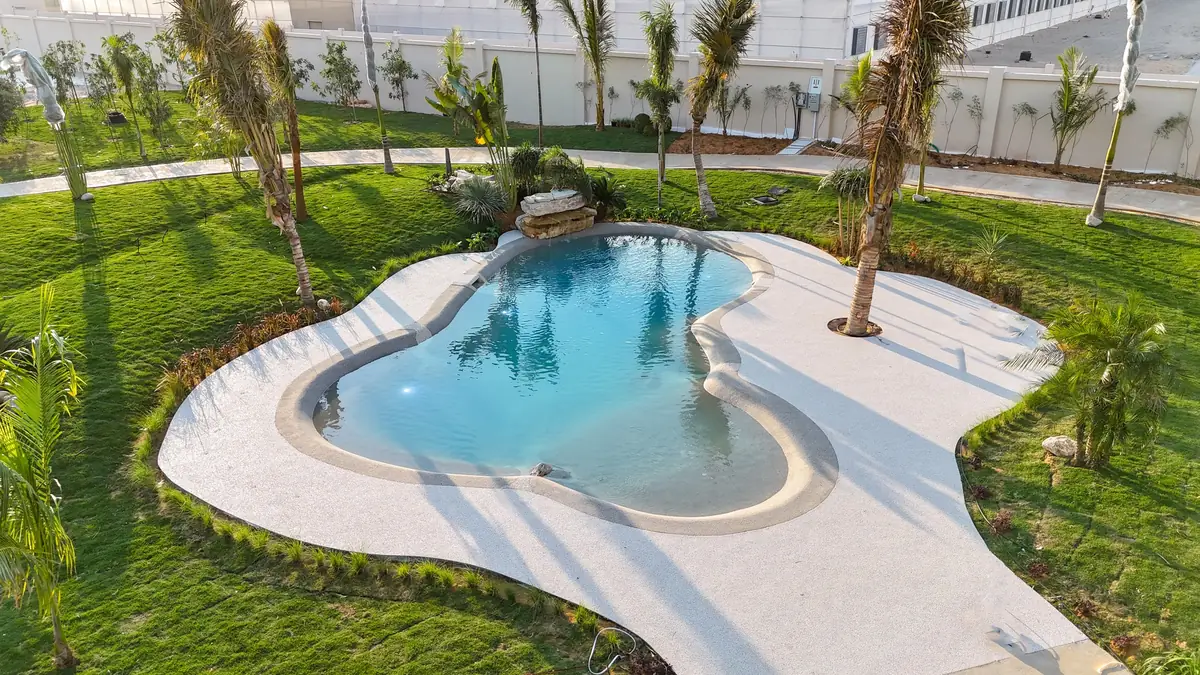
This is one of the reasons we approach the shell differently with our Biodesign beach pool system. Rather than a rigid concrete shell, it uses an engineered stone surface laid over a flexible membrane, built to move with the ground and with heat rather than resist it rigidly. That flexibility is a direct answer to the kind of thermal and ground-movement cracking that can affect conventional concrete construction over time. It does not mean a Biodesign pool can never develop a leak. No pool is immune to every possible fault. It means the structural approach is chosen specifically to reduce that particular long-term risk, which matters a great deal in a climate that puts extreme heat swings on every pool shell in the city.
Whichever type of pool you have or are planning, choosing a builder who treats the shell and waterproofing as the foundation of the project, not a line item to trim, is the most effective long-term protection against leaks of any kind. Our overview of swimming pool construction in Abu Dhabi explains what that quality looks like at the build stage.
Preventing water loss
Whether or not a leak turns out to be the cause, there is a lot you can do to keep water loss to a sensible minimum and make any future check easier.
- Use a pool cover when the pool is not in use, which cuts evaporation significantly by shielding the surface from direct sun and moving air.
- Top up during cooler hours rather than the middle of the day. Fresh water added under direct midday sun evaporates quickly, so early morning or evening top-ups make better use of the water you add.
- Invest in quality construction and waterproofing from the start, since the shell and the systems behind it are what determine whether the pool stays reliably watertight for years, not just at handover.
Consistent basic care also helps you notice a genuine problem earlier. Our beach pool maintenance guide and our guide to Versatile Beach Pool maintenance and running costs both cover the routine that keeps a pool easy to read, so a real leak stands out quickly against a normal, predictable baseline.
When to call a professional
Call in a professional if the bucket test confirms a leak, or if the water loss is sudden or large rather than the slow, steady pattern typical of evaporation. Trying to chase down a structural, plumbing or equipment leak without the right tools usually wastes time and can delay a fix that is actually straightforward once properly diagnosed.
If you are seeing water loss you cannot explain, or you are planning a new pool and want a build that is engineered to reduce structural leak risk from day one, talk to our team and we will help you get a clear answer.